
Skip to Content

Liquid Molding Monthly

10 Best Isolation Mounts for Vibration Control?

Vibration rarely appears as a dramatic failure. It begins with a humming panel, blurred measurements, or bolts that loosen after weeks of operation. The right Isolation Mounts can reduce these problems by separating equipment from unwanted movement. Small changes matter.

This guide examines ten leading options for vibration control across machinery, electronics, pumps, compressors, and sensitive instruments. Each product deserves more than a quick glance at its price. Load capacity, rubber or spring construction, stiffness, damping, frequency range, temperature resistance, and installation method all influence performance. Manufacturer specifications provide a useful starting point, but real suitability depends on the equipment and operating environment. A mount designed for a light control cabinet may fail under a vibrating motor.

Practical selection also requires checking static deflection, uneven loading, floor conditions, and maintenance access. A mount can look strong yet perform poorly when overloaded or installed without proper alignment. No mount is perfect. That matters. Some products offer excellent isolation but require careful setup. Others install quickly but provide less control at low frequencies. The comparisons ahead focus on published technical data, credible manufacturer information, and practical engineering considerations. Where evidence is limited, that limitation should remain visible. Vibration control is not a one-size-fits-all purchase; it is a balance between protection, cost, durability, and measurable performance.
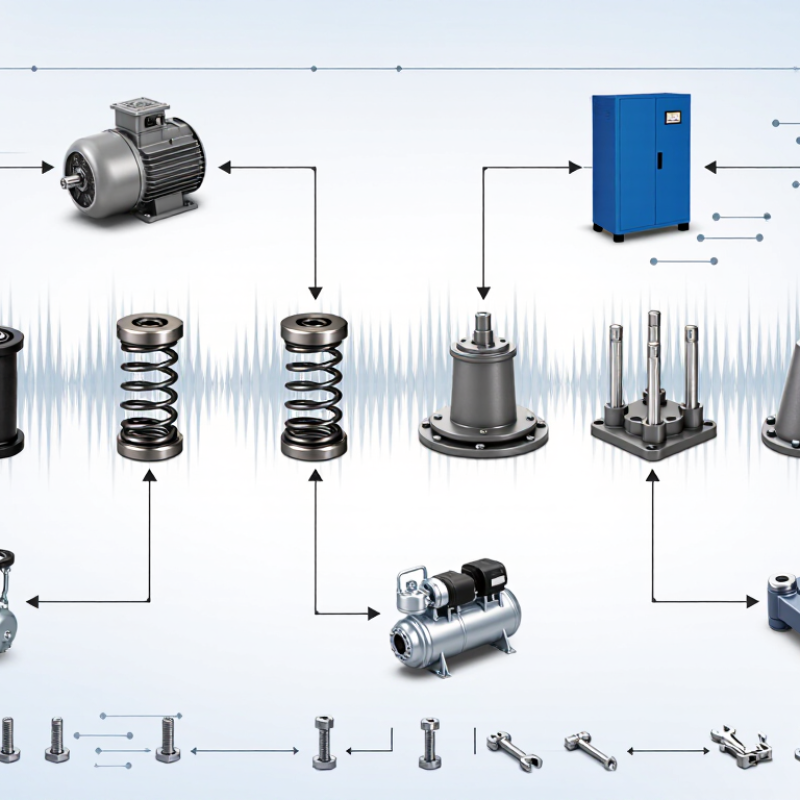
10 Best Isolation Mounts for Vibration Control?

What Are Isolation Mounts and How Do They Control Vibration?

Isolation mounts are engineered interfaces between a vibrating machine and its supporting structure.

They usually combine elastomer, spring, or wire-rope elements. Their job is simple: reduce transmitted force. The mount flexes under load, while damping converts part of the motion into heat. Less reaches the floor.

The key measure is transmissibility, not appearance.

ISO 10846 testing guidance evaluates vibration transfer through resilient elements. In a basic undamped model, a frequency ratio of 3 produces about 12.5% transmissibility. That equals roughly 87.5% isolation. It sounds impressive. Real installations perform differently. Damping, uneven loading, bolts, piping, and frame stiffness can reduce the result. ASHRAE’s 2024 HVAC guidance also stresses natural frequency, operating speed, and equipment weight when selecting isolation systems.

The best isolation mounts for vibration control therefore match the machine’s forcing frequency, static deflection, and environment.

A compressor may need flexible connections and restrained mounts. A precision instrument may need low-amplitude isolation with careful leveling. Check the load at each mount, not only the total equipment weight. A small mismatch can create rocking, like one short table leg.

Field measurements with accelerometers often reveal problems that calculations miss. This step is frequently skipped. That is a weakness. Reviewers should compare measured vibration before and after installation, document the test method, and question any performance claim without frequency-specific data.


Key Factors for Selecting the Right Isolation Mount

Selecting the right isolation mount starts with the machine, not the product catalogue. Record the equipment’s total weight, center of gravity, operating speed, and mounting points. Divide the load carefully among the mounts. Uneven loading can cause excessive deflection, tilting, or early material fatigue.

Target the correct natural frequency for the vibration problem. A mount that feels soft may isolate low-frequency movement better, but it can reduce stability. A stiffer mount may control motion while transmitting more vibration into the floor. Check the supplier’s load-deflection data, not only the advertised load capacity. Small details matter. A few millimeters of deflection can change performance significantly.

Consider the working environment. Oil, moisture, dust, heat, and cleaning chemicals can affect elastomer life. Metal mounts may suit high-temperature areas, while elastomeric designs often provide useful damping. Confirm whether the mount must resist compression, shear, or occasional shock loads. Installation also deserves attention: level surfaces, correct bolt torque, and adequate clearance are essential. In field inspections, poor alignment often causes more trouble than the mount itself. I have seen installations selected correctly on paper but weakened by uneven floors and neglected preload checks. That is worth questioning before replacement. Test vibration at the machine and at the supporting structure after installation, then adjust the design if measurements disagree with expectations.

10 Best Isolation Mounts for Different Vibration Control Needs

Choosing the best isolation mount depends on vibration frequency, equipment mass, movement, and installation conditions. In machine-room installations, elastomeric mounts suit pumps and small compressors because they are compact and easy to adjust. Neoprene mounts resist oil and moisture. Cork-rubber pads work well under cabinets and light machinery. Steel spring mounts provide stronger low-frequency isolation for fans, chillers, and rotating equipment.

Air springs suit precision equipment, optical tables, and test systems needing very low natural frequencies. Wire-rope isolators tolerate heat, chemicals, and repeated shock. Laminated mounts handle vertical loads while limiting lateral movement. Inertia-base mounts add mass beneath pumps, reducing movement through concrete floors. Seismic-rated mounts combine isolation with restraint. Active isolation mounts use sensors and actuators for sensitive laboratory equipment.

Selection needs measurable evidence. ISO 20816 evaluates machine vibration using velocity measurements, often reported in millimetres per second RMS. The European Commission identifies 0.5 m/s² as the daily whole-body vibration action value, with 1.15 m/s² as the exposure limit under Directive 2002/44/EC. These figures do not replace a mount calculation. They indicate why frequency testing matters. A 2024 industrial vibration-control market analysis also reports continued demand for spring, air, and elastomer systems across manufacturing and healthcare facilities. Load data remains critical. I have seen mounts fail when engineers sized only for static weight. That shortcut looks efficient, but it ignores start-up forces, uneven loading, and aging. Floor stiffness matters too.

10 Best Isolation Mounts for Different Vibration Control Needs

Representative nominal natural-frequency values for common isolation-mount designs. Lower natural frequency generally provides better isolation when the excitation frequency is sufficiently higher than the mount’s natural frequency. Actual performance varies with load, preload, temperature, and installation.

Typical engineering ranges are shown for comparison and are not tied to any specific manufacturer or product.

How to Compare Load Capacity, Materials, and Performance

Choosing the 10 best isolation mounts starts with load capacity, not popularity. Calculate the equipment’s operating weight, center of gravity, and load per mount. Add a realistic dynamic factor for start-up, imbalance, and shock. A mount rated for 500 kg may perform poorly when it carries 125 kg unevenly. Deflection matters too. Greater deflection usually lowers the natural frequency and improves isolation, but excessive movement can damage connected piping or cables.

Material changes performance. Rubber offers useful damping and simpler installation. Spring elements often provide lower frequencies, but they need restraint against sway. Wire-rope designs tolerate heat, oil, and harsh environments. Compare hardness, fatigue life, temperature range, and chemical resistance, not just price.

The U.S. Department of Energy reports that motor-driven systems consume about 68% of industrial electricity in its sourcebook, “Improving Motor and Drive System Performance.” Better vibration control can protect this energy-intensive equipment, although isolation alone does not fix poor alignment. ISO 20816 also supports evaluating vibration severity through measured velocity and operating conditions.

Tips: Measure vibration before selecting a mount. Record speed, direction, and load changes. Check the manufacturer’s static and dynamic ratings. I would question any claim without test conditions.

A simple field mistake is mounting four isolators while assuming equal loading. Real frames rarely distribute weight evenly. Review the weakest mount, the lowest operating temperature, and the largest expected shock. Then verify results with an accelerometer after installation. Small errors become expensive noise.

Installation and Maintenance Practices for Better Isolation

Selecting among the 10 best isolation mounts for vibration control is only part of the solution. Proper installation determines whether the mount performs as intended. Begin by checking the equipment weight, center of gravity, and operating speed. Uneven loading can compress one mount too far while leaving another nearly inactive.

Place each mount on a clean, level surface. Remove oil, dust, and loose paint from contact areas. Use calibrated tools to tighten fasteners evenly. Do not pull equipment into alignment with excessive force. That shortcut can twist the frame and transfer vibration through the bolts. Leave enough clearance around each mount for inspection and movement.

Measure the equipment height before and after installation. A noticeable difference may indicate incorrect loading or a damaged component. During operation, inspect for cracking, flattening, unusual noise, and shifting hardware. Check again after the first week, then follow a practical inspection schedule based on operating hours and vibration exposure. Small changes matter.

In field work, I have seen quiet equipment become unstable because one mount was installed upside down. The mistake was easy to miss. I also learned that maintenance records should include photographs, measured deflection, and tightening results. Guesswork is unreliable. Replace damaged mounts in matching sets when possible, but review the load distribution before ordering replacements. Even a well-designed isolation system can fail when the surrounding structure is weak.

100% Mercury Free

100% Mercury Free

All of Hapco's formulations are completely free of Mercury.

50 Year Track Record

50 Year Track Record

Hapco has been in business for over 50 years!

ISO Certified

Higher Quality. More Efficiency. View Certificate

Technical Expertise

Hapco's employees are knowledgeable and ready to help.

Join Our Mailing List

Get the latest news, updates, and articles from Hapco, Inc.

Join Now